- Sie befinden sich:
- Fachbücher
- »
- Politik & Gesellschaft - Unsere Neuheiten
- »
- Soziologie
- »
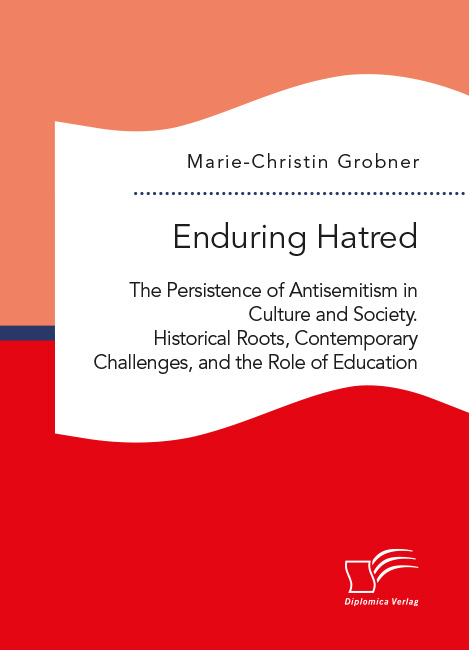
- Enduring Hatred: The Persistence of Antisemitism in Culture and Society. Historical Roots, Contemporary Challenges, and the Role of Education
Soziologie
» weitere Bücher zum Thema
» Buch empfehlen
» Buch bewerten Produktart: Buch
Verlag:
Diplomica Verlag
Imprint der Bedey & Thoms Media GmbH
Hermannstal 119 k, D-22119 Hamburg
E-Mail: info@diplomica.de
Erscheinungsdatum: 02.2026
AuflagenNr.: 1
Seiten: 136
Sprache: Englisch
Einband: Paperback
Antisemitism continues to threaten Jewish life, culture, and security despite international efforts to combat it. It infringes on basic human rights such as freedom of speech, religion, and cultural expression. The study reviews interventions aimed at addressing antisemitism, particularly through education, and shows that antisemitism persists independently of Jewish population size, being rooted in myths, media, and culture. Education is identified as key to preventing antisemitism. The research uses a systematic review approach to assess various educational interventions and underscores the importance of rigorous selection criteria to avoid bias in research outcomes.
Textprobe: INTRODUCTION AND BACKGROUND Context Despite international efforts to eradicate it following the horrors of Nazi Germany and its allies and collaborators, antisemitism threatens the Jewish way of life, culture, and security. (Langmuir, 1990). Jews are still persecuted solely because of who they are. Their right to free speech, religious liberty, and cultural expression, as well as their freedom from prejudice and fear, are all violated by antisemitism. Additionally, when antisemitism spreads, it harms the entire nation. Antisemitism challenges the fulfilment of all people's human rights by encouraging views rooted in hatred, prejudice, and identity inequality. Antisemitism arises regardless of whether there is a Jewish community since the prevalence of Jews and the level of racism do not directly correlate with one another. As opposed to that, it lives as a mindset that is reflected in myth, conspiracy, iconography, culture, and society, taking stale tropes and reinventing itself in novel ways. Recent violent acts that killed Jews or were motivated by antisemitism, such as those that occurred in, among others, Brussels, Copenhagen, Paris, Mumbai, and Toulouse, are considered the most severe instances of antisemitism (Volkov, 2011). In order to propagate anti-Semitic propaganda, Nazism has been lauded alongside fabrication on social media and the internet and Holocaust Denial. Attacks on Jewish educational institutions were reported in 2016, and they occurred in Denmark, Belgium, Germany, the United States, and Italy. Antisemitism has also been disturbingly present on a number of college campuses. Antisemitism needs to be combated through education, just like all other forms of prejudice and discrimination. Since prejudice is frequently learned, education can be vital in addressing it, eradicating it, and combating social inequality (Simonsen, 2020). Additionally, education promotes a feeling of global citizenship and solidarity, appreciation for diversity, living in peace as active, democratic citizens, and respect for and pleasure of differences. This is because antisemitism thrives in an environment of ignorance and prejudice. Due to the complexity of antisemitism, practitioners and educational leaders must follow their unique academic criteria to approach it correctly and confidently. An overview of anti-Semitism Since its introduction in the late 1870s, the term antisemitism has come to refer to all forms of Jew-hatred, both conventional and contemporary. The notion that as Hebrew is a language of the Semitic group, Jews must, therefore, be Semites is where the term Semite originates. (Langmuir, 1990). In the same way that many other languages, like Arabic and Ethiopic, are members of the Semitic language family, different ethnic groups could also be referred to as Semites. Jew-hatred, however, does not exist. because antisemitism does not involve prejudice against other communities (Volkov, 2011). The term itself is a superb illustration of how antisemites in the late nineteenth century claimed that their prejudice was founded on philosophical and scientific principles. Since ancient times, Jews and Judaism have been the target of prejudice and discrimination. Jewish scholars have identified the prototypical forms of antisemitism in the Bible, from the rivalry between Esau and Jacob to the attempted exterminations ordered by Pharaoh and Haman and Amalek's attack in the wilderness (Marrus, 2021). Along with myths and folklore, mistrust, and terror, a pattern of successful proselytizing throughout the ancient world would suggest a receptivity or sympathy to Judaism. Regardless of what one believes about the anti-historical Judaism's roots, it is evident the situation was fundamentally altered by the introduction of Christianity. Many analysts believe that elements of Christian theology are deeply ingrained with the foundations of contemporary antisemitism (Soyer, 2019). Since Christianity emerged from Judaism, it was necessary to separate from Judaism and forge a new identity. The reason Jews, who believed the Bible to be God's inspired word, rejected the Messiah and the faith foretold in those books as belonging to Christians was also brought up. It was either the Jewish interpretation of the Bible or was wilfully and intentionally discarded, or the Christian interpretation was erroneous. In many aspects, traditional antisemitism is founded on Christians' religious prejudice against Jews. Soyer (2019) states that the notion that Jews should be punished for the crucifixion of Jesus was established in Christian belief (this myth is often referred to as deicide or the slaying of God.) According to the Supersession Myth, Christianity had displaced Judaism as God's preferred religion because Jews had failed in their role as such and hence merited punishment, specifically from the Christian world, built on this anti-Jewish sentiment. Numerous prejudices about Jews have developed over the years. Individual Jews were not assessed according to their talents or accomplishments instead, Jews as a whole were viewed as being avaricious, wicked, aloof, sluggish, money-hungry, and oversexed (Marrus, 2021). This fundamental trend would continue to govern Jewish history in Europe well into the medieval period. During this time, other stereotypes, as well as one of the ideas that Jews are financial manipulators, started to take shape in Norwich, England there was allegedly the first incident of ritual murder, or the claim that Jews tortured and killed Christian new-borns, in 1144 was documented (Waxman, Schraub & Hosein, 2022). According to this accusation, Jews performed rituals involving Christian children's blood at Passover (for instance, to make the unleavened bread served at Passover or to substitute for wine when drinking). A charge of host desecration was brought up about the same time. This myth holds that Jews tortured and mutilated Jesus' body as they had done during the Crucifixion by tricking Christians who owed them money into giving them the host or wafer (used at Mass) (Waxman, Schraub & Hosein, 2022). (The Catholic doctrine of transubstantiation, which maintains that the wafer and wine used in sacraments transform into the actual body of Christ, made this accusation significantly damaging.) Antisemitic stereotypes frequently use these pictures, proving to be lethal and pervasive, persisting well into the twenty-first century. The Jews were forced into exile in 1492 due to Spain's conversion to Catholicism, which also saw the creation of the Inquisition. The Inquisition only had the power to purge heretics from Christianity it had no jurisdiction to pursue unconverted Jews (Smith & Schapiro, 2019). The Spanish first adopted the idea of blood, making the conversion of Jews an insufficient defence. With Mohammad, Islam's formative years lasted until the religion had gained substantial ground. Mohammed's early Jewish opponents and victory over Medina's Jews are described in the ancient book of revelation known as the Koran (Goldberg, Ury & Weiser, 2021). Mohammed also acknowledged Jewish connection and welcomed them as people of the book. As a result, there was a fundamental contradiction in how the Jews were perceived—on the one hand, they were Abraham's offspring, but on the other, they were corruptors of the Bible (Goldberg, Ury & Weiser, 2021). This ambivalence manifested itself in the two functions of tolerance and tribute. Jews were given the title of dhimmi once they accepted to honour them in remembrance of their exploitation and exploitation. In return, they were granted the right to freedom of religion, some civic liberties, and the chance to benefit economically from some later Islamic world successes. Nevertheless, as Islam's power waned, Christians—especially those from Europe—began expressing religious and commercial interests. Even if the blood libel was a precursor, it was not until the nineteenth century that allegations of ritual murder and antisemitic writings from European Christians, especially the French, reached the Muslim world (Lange, 2019). Racial antisemitism, which was never expected in the Islamic world for obvious reasons, was the only thing that was missing. To feed its zeal, however, Islamic fundamentalism today uses a variety of anti-Semitic and anti-Zionist tropes as well as a general anti-Western and anti-secular worldview. The Enlightenment, a philosophical movement that placed reason ahead of conventional orthodoxy in religion and improvements in social, humanitarian, and political realms, emerged in the nineteenth century (Lange, 2019). Antisemitism, however, did not go away during the Enlightenment it simply took on new forms. In many European nations, Jews had equal rights and were made accessible. However, many others showed antisemitism by doubting the sincerity of Jews' allegiance to the newly formed nation-states. Reformers opposed to political and industrial changes asserted that Jews were behind the changes. In the 1870s, racial antisemitism joined the new political antisemitism, according to Rosenfeld (2019). Jews-haters began asserting that Jews were a lesser race on the evolutionary scale by misrepresenting the revolutionary theories of evolution advanced by the English biologist Charles Darwin, who was not antisemitic. Despite assimilation, their issue could never be resolved because it was physical or genetic. The notion that Jews are to blame for the problems in the world because of their race is a part of this new antisemitism. This way of thought was expressed in the Voelkisch movement, a political, nationalist philosophy in Germany. The representatives of this organization believed that industrialisation and secularism would threaten traditional German culture (Rosenfeld, 2019). They asserted that German Jews were not indeed a part of the German nation and that Jews were to blame for the decline of the Germans' traditional way of life. Many antisemitic political groups began to emerge in Germany around the end of the nineteenth century, and these parties were further revived following Germany's defeat in World War I. Antisemitism peaked in France in the 1890s with the Alfred Dreyfus Affair, which involved a Jewish anti-Semitic army commander who was falsely accused of treason (DellaPergola, 2019). Antisemitism was a recognized government policy in Russia during the Czars' control. Jewish migration was confined to specific locations, and the ruling class made pogroms worse. Because many Jews participated in the October Revolution, antisemites in Europe now had an additional reason to accuse Jews of being behind the Communists they detested. Jews did not receive equal rights until the February Revolution of 1917. The Nazi Party was a racial and anti-Semitic political movement that was established in 1919 and reached its height of power in 1933 in Germany. Beginning with the establishment of racial rules that separated Jews from the rest of society and kept the mass killings of people of the inferior race going, the Nazis discriminated against the Jewish people (DellaPergola, 2019). Local antisemitism, whether historical, political, or racial, affected how Jews were treated in countries that sided with the Nazis or were under their control. Antisemitism persisted even in the nations that resisted Hitler and the Nazis. Some analysts think these attitudes prevented those countries from acting more to save Jews from the Nazis. As per Beyer (2019), all the threads of antisemitism from the past came together during the Holocaust to create a system to eliminate all Jews, particularly in Europe. Jews were theologically denounced, stigmatized, and dehumanized (by being called Untermenschen or subhuman). Both capitalist and communist economic manipulators were charged against them. They were portrayed as racial bloodline contaminators, sexual corruptors, and German traitors who were to blame for Germany's defeat in World War I. These themes were represented in Nazi-era art. Jewish artists and work were outlawed because they either created degenerate or corrupt art. Nazi stereotypes of Jews were based on long-standing antisemitic parodies (Beyer, 2019). Jews were portrayed as ugly sexual corrupters, corpulently gross money manipulators, or ritual killers in works like Der Steurmer, children's literature like The Poison Mushroom, adult publications, and movies like The Eternal Jew. The photos from the medieval originals were periodically modified to support the unrestrained historical assertion of Jewish wickedness. In other instances, both the original pictures and the updated versions were published in the same source. For every single anti-Semitic comment printed in print, a caricature may be included. On kiosks throughout German cities, the worst photos from Julius Streicher's semi-pornographic journal Der Steurmer and publishing company were prominently displayed. When the West learned what had transpired in Europe after World War II, antisemitism lost its credibility. Many churches concurred that it was a grave error to embrace traditional Christian antisemitism (Pope John Paul II termed antisemitism a sin). Nazi pseudo-racial doctrines were debunked by science, and many nations stopped implementing antisemitic laws. Soon after the war ended, Joseph Stalin began punishing his nation's Jews out of paranoia, which revived antisemitism in the Soviet Union. Additionally, antisemites started disguising their hate of Jews under the banner of anti-Zionism throughout time, notably extreme Muslims who were against Israel's establishment (Lipstadt, 2019). When the United Nations adopted a resolution declaring that Zionism is racism, this campaign reached its zenith. In the end, this resolution was revoked in 1994. Two more manifestations of antisemitism in contemporary society that try to defend or celebrate Nazism and earlier antisemitic acts are Holocaust denial and Neo-Nazism. Extreme nationalist beliefs from the past reappear across Europe, and some sections of the populace are working to revive old-fashioned bigotry, including antisemitism. The Middle East conflict is still sparking antisemitism. Anti-Zionism has replaced antisemitism as the cover for animosity toward Jews in society's more respectable groups. This hostility is conveyed through the use of double standards, comparisons to Nazi Germany, and other extreme kinds of rhetoric (as with any other nation), in contrast to the justified criticism of the State of Israel (Lipstadt, 2019). Because of this, modern anti-Zionism, which may be found on both the left and the right, frequently represents a new form of antisemitism. International organizations now take the lead in combating antisemitism. These groups take part in coalition-building, political and social action, education, research, awareness-raising, and remembrance initiatives to fight racism in general and antisemitism in particular. George Santana's oft-repeated saying that those who do not learn from history are destined to repeat it is tied to the emphasis on the history of antisemitism, which includes the creation of Holocaust monuments and museums (Volkov, 2011). The Impact of Antisemitism Antisemitism is a danger to all societies and a sign of more serious social issues. Jews and those who are seen as Jews in societies are the subject of anti-Semitic harassment, violence, and discrimination, which also occurs online and on social media (Lange et al., 2020). Synagogues, schools, and cemeteries are among the Jewish institutions that frequently face violence and destruction. State of Israel's emblems and guiding principles have occasionally been reinterpreted in recent years to stand in for individuals, groups, or objects perceived as Jewish or associated with the Jewish community. They are now the focus of attacks and prejudice as a result of this misunderstanding, often with an undercurrent of anti-Semitism. While the victims of specific attacks are affected right away, anti-Semitic hate crimes and threats also have a long-term impact on Jewish people's daily lives and human rights: Jewish people may feel afraid to attend worship services, go into synagogues, or wear distinctive religious clothing or symbols, which harms people's freedom to practice their religion openly (Lange et al., 2020) Jews may choose not to identify themselves as Jews in public, Jews may be effectively excluded from public life when they exhibit their cultural identity, participate in Jewish cultural events, or both Jews may self-censor in places such as work, school, online forums, and social gatherings, denying themselves the opportunity to exercise their First Amendment freedom of speech, especially when it comes to showing support or affection for Israel (Enstad, 2021) In some countries, significant security measures are required for Jewish schools and youth activities to operate owing to anti-Semitic violence or fear of it (Enstad, 2021). Instead of being carried by the government, this financial burden is typically carried by Jewish institutions, taking moey away from activities related to religion, culture, and education. Antisemitism also affects the general populace. Unchecked or thriving antisemitism influences young people and society to accept prejudice, active discrimination, and even violence against certain groups of people (Lipstadt, 2019). Such a belief produces both short-term and long-term challenges to general security, as has been amply shown by past events. Governments and policymakers must acknowledge the danger of inaction to lessen it.
Seit 2021 Hochschullehrgangsleitung für Freizeitpädagogik und Lehrende an der PH NÖ, 2022-2024 stellvertretende Leitung der Praxisvolksschule der PH NÖ, davor seit 2012 als Volksschullehrerin tätig, seit 2025 Doktorandin der Pädagogik Uni Wien Leitung des Forschungsprojekts WERTvolle Bildung - Demokratiebildung & Antisemitismusprävention an der PH NÖ
weitere Bücher zum Thema

Einführung in die interkulturelle Kommunikation. Höflichkeitsformen im deutsch-arabischen Kontext im Fokus
ISBN: 978-3-69122-508-2
EUR 34,50
Der Landlatanz des Innviertels. Form und Funktion in Historie und Ethnomusikologie
ISBN: 978-3-69122-504-4
EUR 34,50
Identität. Durch aktive Rollengestaltung zu mehr Lebensqualität
ISBN: 978-3-69122-500-6
EUR 24,50
Der Mensch ist wesenhaft frei. Interreligiöse Elementarpädagogik und Multireligiosität als Schlüsselbegriff im 21. Jahrhundert
ISBN: 978-3-96146-989-5
EUR 49,50
Antisemitismusprävention in der Grundschule und Sekundarstufe I. Geschichte, Ansätze, Konzeptformulierung und Lernmaterialentwicklung für Klassenstufe 4-6
ISBN: 978-3-96146-971-0
EUR 49,50
Stuttgart 21: Scheindiskurs oder ideale Sprechsituation? Diskursanalyse der Schlichtung zu Stuttgart 21 anhand von Videosequenzen
ISBN: 978-3-96146-972-7
EUR 34,90
Waffenverbote in Deutschland. Potential und Schwächen von Waffenverbotszonen als kriminalpräventives Konzept zur Verhinderung von Gewaltdelikten unter Einsatz von Messern
ISBN: 978-3-96146-965-9
EUR 34,90
Käthe und Gusti. “Die raue Nazi-Wirklichkeit lehrte uns, keine richtigen Deutschen zu sein.“
ISBN: 978-3-96146-959-8
EUR 24,99
Förderung der Lesekompetenz bei Schülern mit Migrationshintergrund. Methodisch-didaktische Konsequenzen für den integrativen Deutschunterricht
ISBN: 978-3-96146-960-4
EUR 34,90
Systemisch-tiergestützte Intervention bei Familientrauer. Wie Tiere Familien bei einem Verlust unterstützen können
ISBN: 978-3-96146-950-5
EUR 34,50